Designed in 1999, the bridge connects Piazza Gentile da Fabriano, in the Flaminio district, with the Lungotevere Cadorna at the height of the swimming stadium at the Foro Italico, in the Delle Vittorie district. Construction work began in 2008.
The intervention is part of the Music and Arts Park Project, structured in an east-west direction on the Villa Glori - Monte Mario axis along the axis of Via Guido Reni up to the access to the South Gate of the Monumental Sports Complex of the Foro Italico. The work elegantly and lightly underlines the strong social and urban bond that has been created in recent decades between the Flaminio district and the Delle Vittorie district.
Costing about 8 million euros, the Ponte della Musica is based on the winning project of an International Design Competition, drawn up by Buro Happold of London, a studio known internationally (its works can be admired in Abu Dhabi as well as New York), subsequently joined by the Soc. Carlo Lotti & Associati of Rome, one of the oldest Italian engineering companies, specializing in the construction of bridges and dams.
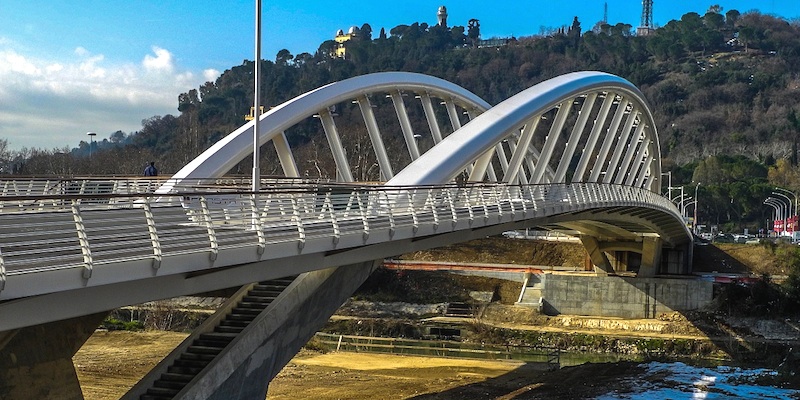
The executive design was carried out by ATP Mario Petrangeli Associati srl with the Studio Biggi-Guerrini. The construction management, under the direction of Franco Policicchio, was entrusted to Atp Carlo Lotti & Associati and Buro Happold. The bridge, designed and built for pedestrian, cycle and public transport traffic, is made up of a metal deck supported by two low steel arches resting on reinforced concrete abutments, which contain the access stairs to the two banks of the river.
The dimensions of the deck are 190 meters long, 22 meters wide at the center and 14 meters at the ends. The free arch has a span (distance from one abutment to the other of the bridge) of approximately 190 meters. The total weight of the structure is 2000 tons.
The solution proposed and implemented by the designers is characterized by the inclination of the two arches with respect to the vertical plane and the absence of a horizontal connection between them in the area above the deck, to allow a particular sinuosity and brightness of the architectural image. The Ponte della Musica houses a corridor in the central part that is prepared for protected public transport.
The structure is founded on piles while the left abutment is placed on movable bearings capable of absorbing thermal and seismic stresses. The central part is paved while the lateral ones are made of wooden slats resting on the steel structure.
Are you a local? What do you think about Bridge of Music - Armando Trovajoli?
Login to suggest it!


















 Find the best hotel offers and save up to 80%