THE MUSEUM
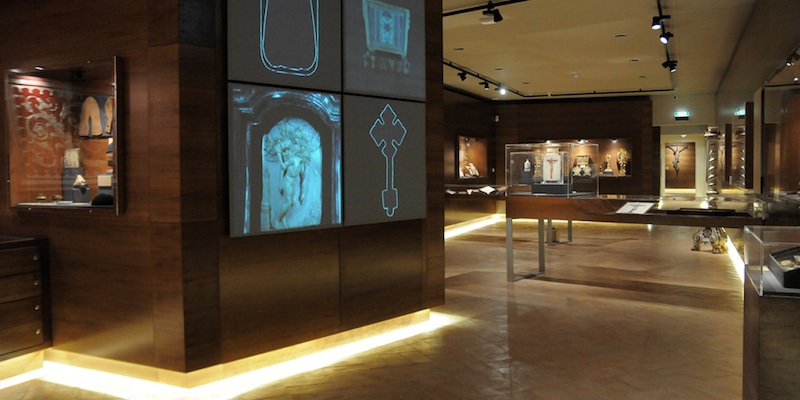
The Museum of the Capuchin Friars Minor of the Roman Province was born with the objective of highlighting the spirituality of a religious Order based on intense mysticism, a simple and sober lifestyle, a constant closeness to the people and a strong and sweet spirit of brotherhood.
The eight rooms of the museum, located within the convent, show as many sections that go back to the origins of the place, retrace its history and present the lives of those who, becoming religious, are inspired by the exemplary testimonies of the Capuchin saints such as Saint Felix of Cantalice, Saint Crispin of Viterbo, Saint Joseph of Leonessa, etc., but also by contemporary figures of vast public resonance such as, for example, Saint Pio of Pietrelcina, stigmatized for 50 years and Father Mariano of Turin, the first multimedia preacher.
The first section is dedicated to the Convent, commissioned by the Barberini family in 1626 and completed in 1631, as an extensive conventual complex with the church dedicated to the Immaculate Conception and according to the project by the Capuchin architect Fra Michele da Bergamo.
The second section presents the history of the Order, one of the most widespread in the world, combining the paintings of the Fathers General and the archive documents, some insights into the saints and the Capuchin convents of the Roman Province.
The third section, Capuchin Sainthood, goes into detail about Capuchin spirituality through the images and stories of some saints of the Order.
The fourth section, the largest in the museum, highlights Culture and Spirituality through the exhibition of liturgical vestments and objects and that of everyday artifacts. This section is also enriched by some educational insights, such as the theme of the crucifix, and the "bleeding crucifix".
The fifth section is dedicated to "Saint Francis in Meditation", a work by Caravaggio, created specifically for the Capuchin Convent.
Through the sixth section The Capuchins in the 20th century, where there is a particular focus dedicated to the Venerable Father Mariano of Turin, and the seventh, The Capuchins in the world, the exhibition path reaches the present day showing something of the spiritual, cultural, missionary and artistic activity that has characterized the Order in the 20th century: documents, materials and archive works of some Capuchin religious propagators of the Gospel are presented, who have used ancient and new instruments, techniques and forms of communication.
At the end of the exhibition path, the eighth section introduces the conclusive and suggestive place that closes the museum visit: the Crypt.
The Museum also presents itself as a new center for the preservation of the historical and artistic heritage of the Capuchins of Rome and Lazio. The exhibition halls, in fact, have been designed not only to house and exhibit artistic materials but also for their preservation. To this end, an important restoration campaign preceded the opening of the Museum, restoring to their original splendor various types of works of art, volumes and documents but above all liturgical objects and everyday Capuchin artifacts, strongly characterized by that spirit of "self-production and poverty" specific to the Order.
THE CRYPT
A singular work of art, created around the first half of the 18th century, the Crypt arose from the practical need to make room for new deceased in the small convent cemetery and therefore to find a proper place for the bones of the exhumed friars. The ingenious composition becomes an excellent opportunity for the wholly positive announcement of the Christian meaning of human life and its arrival at resurrection.
In 1631 the Capuchin Friars left the convent of Santa Bonaventura, near Fontana di Trevi, and came to live in this current one of the Immaculate Conception of the Blessed Virgin Mary in Rome, where the remains of the deceased religious were transported and placed.
Father Michele da Bergamo, Capuchin architect, in his "Memoirs", writes that, in April of that year, he transported here, from the old convent, the remains of Saint Felix of Cantalice then "also the body of the Reverend Father Francesco Bergamasco, with all the Bones of other Friars, and also those of the Lord Marcantonio and Prospero Corteselli, placing them in a particular place". The bones were arranged in a certain order along the walls and they began to bury friars and also the poor of Rome, to whom the sepulcher placed in the floor of the chapel for Mass was reserved.
The first time that "niches, vaults, some ornamentation of the ceiling with regular and pleasant designs, lamps, crosses, etc." are mentioned. It can be assumed that the work of decorating the crypt was carried out in the years 1732-1775. In this place, consisting of a corridor about thirty meters long, flanked, currently, by six rooms, the mortal remains of about 3,700 deceased have been collected, mostly Capuchin friars. Tradition has it that the earth of this cemetery is holy, because it was transported here from Palestine or even from Jerusalem.
It has been hypothesized that the "ingenious artist" who executed the decoration must have been Father Raffaele da Roma, a talented Capuchin painter, who died in Rome in 1805. Others have identified the designer of this "funeral monument" in Father Norberto Baumgartner from Vienna (1710-1773), a well-known Capuchin painter, certainly present in the convent of Rome in 1745; some of his works remain in the church above the cemetery. But the name of Ennemond (Edmond) Alexandre Petitot (1727-1801), who was in Rome from 1746 to 1750, has also been mentioned.
Are you a local? What do you think about Museum and Cappuccino Crypt?
Login to suggest it!



















 Find the best hotel offers and save up to 80%