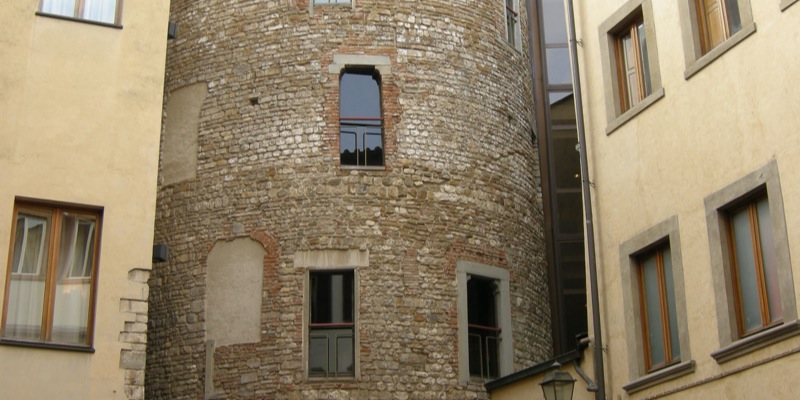
The Pagliazza tower is located in the small square of Sant'Elisabetta, in the oldest part of the center of Florence. The origins of this structure, often referred to as the oldest building in Florence that has maintained its original appearance, are uncertain, dating back to between the 6th and 7th century, although it rests on older Roman foundations. During excavations carried out during the last restoration, it was discovered that the foundations of the building indeed rested on a Roman structure, the only one known in this part of the city. The tower actually leans on a circular wall that enclosed a pool or a room of a thermal structure from Roman Florentia, the secondary baths (public or private?) after the main ones near the Ponte Vecchio (today under via delle Terme). This exedral structure, used as a base, is thought to have determined the unusual semi-circular shape of the tower, a nearly unique case in Florence, alongside another partially preserved nearby on via delle Terme and perhaps belonging to the ancient caput aquae of the Roman aqueduct, the "Capaccio." The circular shape is reminiscent of the Roman walls and is quite rare in the medieval period. The excavations revealed the original brick floor and some ancient walls. The tower was then raised, according to some theories, by the Byzantines, when they entered the city during the Gothic War as part of the fortification of the reduced ring of walls (the real existence of which is still debated by archaeologists), according to other theories by the Lombards a century later, as a simple tower house. During the early Middle Ages, little is known about the fate of the building, and the excavations have not revealed structures or materials pertinent to this period. Starting from the 12th century, the information becomes more precise, when it is cited in 1268 as a prison, while in 1285, its female designation is specified. The name of the tower would actually derive from the straw mattresses on which the detainees lay. Subsequently, the tower was repurposed as a bell tower for the church of San Michele alle Trombe or in Palco or in Palchetto, which was renamed in the 13th century as the church of Sant'Elisabetta, of which some traces remain in the adjacent building (a baptismal font and some paintings). The church was used until 1785, then absorbed into a curtain of private housing. Today, the tower and the adjacent buildings house a hotel, although the structure is owned by the National Insurance Institute, which financed a restoration and enhancement process deemed exemplary by many, designed by architect Italo Gamberini (1983-1988). The restoration has freed the tower from the structures that covered it from view from the street, bringing it closer to its appearance in the 15th century, as documented by an illustration from the Codex Rustici, when small shops were opened on the ground floor, after the cessation of use as a prison, while the upper floors were used as residences and storage. To show the archaeological finds from the excavations, a small museum has been set up at the base of the tower, visitable upon request. The excavations have also yielded a considerable number of ceramic pieces, mainly dating from the 16th and 17th centuries. The first display case shows a dense selection of Roman sherds found in the oldest excavation layer. The pieces are not numerous due to the repeated use of the places in later periods, and they do not have particular artistic value, but they are an interesting testimony to the site's history: some indeed date back to the founding period of Florentia (1st century AD), while higher up is a "level of abandonment" datable to the 4th-5th century AD, with ceramics pertaining to this period recognizable by red glazes and impressed decorations. The second display case highlights the chronological gap of finds related to the early Middle Ages and the early centuries of the low Middle Ages. The displayed items are indeed fragments of pottery from the 14th century, with various shapes characterized by elegant decoration. The Renaissance and post-Renaissance ceramics represented can be divided into three categories: majolica, coated, and graffito, mainly from Montelupo production. Notable are large plates in a comprehensive style, featuring animals, views of villages, or human figures at the center, in addition to richly decorated 16th-century bowls featuring colorful geometric patterns. Another display case showcases more significant works of Montelupo's ceramic manufacturing, such as those decorated with the "blue graffito" technique, or the "harlequins" (first half of the 17th century) with large painted figures. The large trays with coats of arms at the center are also of high value.
Are you a local? What do you think about Tower of Pagliazza - Museum of Pagliazza?
Login to suggest it!




















 Find the best hotel offers and save up to 80%