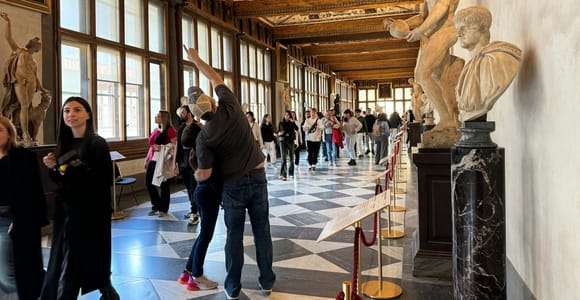
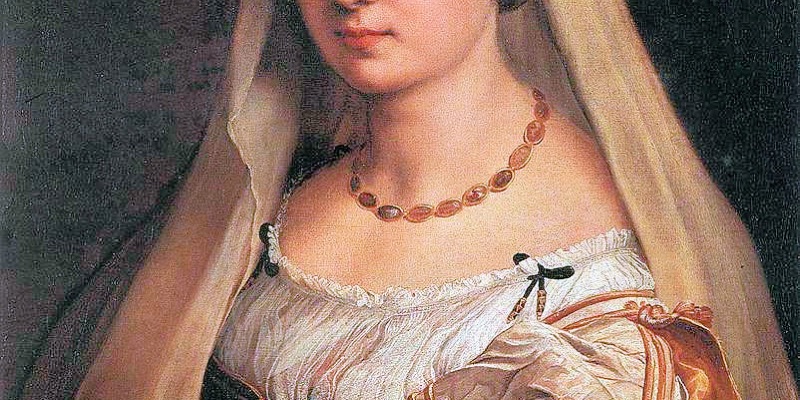
The Palatine Gallery is a museum housed in the Pitti Palace in Florence. It is the "private gallery" of the Grand Dukes of Tuscany: the arrangement reflects the taste of the picture galleries of the 17th and 18th centuries, with paintings placed in several rows selected by decorative criteria rather than by periods or schools. Chronologically, with a few exceptions, the paintings mainly cover the 16th and 17th centuries. The Palatine Gallery also preserves the largest collection of paintings (excluding frescoes) by Raphael in Italy, the second largest in the world after that of the Louvre, and the largest Italian collection of paintings by Titian. It is located in some of the most beautiful halls of the Palace (which is where the name "Palatina" comes from, meaning of the Palace), on the noble floor. The superb collection of paintings on display (over 1000 paintings today) is centered around the late Renaissance and Baroque period, the golden age of the palace itself, and it is the most important example in the world of a picture gallery, where, unlike a modern museum setup, the paintings are displayed with purely decorative criteria, covering the entire surface of the wall in symmetrical patterns, very faithful to the original arrangement wanted by Grand Duke Peter Leopold between the late 18th and early 19th centuries. In particular, during that period, a part of the immense Medici heritage that could not all be exhibited at the Uffizi due to space reasons was arranged in the palace, generally leaving there, with necessary exceptions, the works from the early period of the Renaissance, up to the early 1500s. For this reason, the vast majority of the works are painted on canvas since the technique of painting on panel was gradually abandoned from the second half of the 15th century, being more labor-intensive in preparation and producing works that were obviously heavier and more difficult to transport and hang on walls, according to new fashions. The arrangement as a gallery enhances the beautiful carved and gilded frames, while besides the paintings, the rooms are also enriched by sculptures and pieces of fine furniture, such as wonderfully inlaid tables and cabinets made of hard stones according to the art of Florentine commesso, practiced since the 17th century by the Opificio delle Pietre Dure. The same ticket today also gives access to the museum of monumental apartments and the Gallery of modern art. The museum's core is made up of about 500 paintings that testify to the personal collecting taste of various members of the Medici family and which passed to the city of Florence in 1743 by the testamentary will of the last heir of the dynasty, Anna Maria Luisa de' Medici, who managed in this way to prevent their dispersion, as instead happened to similar collections in Rome or Urbino, scattered or merged into other collections from foreign countries due to complicated hereditary and dynastic issues. The exceptional collections of Vittoria della Rovere, wife of Grand Duke Ferdinand II and the last heir of the Dukes of Urbino, were also preserved in Palazzo Pitti, which included a large number of canvases by Raphael and Titian. Peter Leopold, as mentioned, divided the paintings and sculptures (ancient and modern) roughly between the Uffizi and Palazzo Pitti in his rationalization program of every aspect of the city, while the gems, natural and scientific curiosities became the original nucleus of the Museum of Natural History. The first opening to the public dates back to 1833, with a particularly exceptional nucleus of works by Raphael, Andrea del Sarto, and Titian, as well as all the masters of the Florentine school between the 15th and 16th centuries, notable examples of the contemporary Venetian school and some famous works by Caravaggio, Rubens, and Van Dyck. Often, the paintings with sacred subjects, originally meant to embellish the altars of various churches, were purchased by both the Medici and the Lorraine in exchange for copies or modern works made for the occasion; however, the relocation from church to palace often involved the alteration of the paintings, with cuts and additions necessary to standardize dimensions to create compositions of fanciful geometries on the walls. Often, paintings from different eras and authors were paired for their theme, the composition of the scenes, or simply for aesthetic similarity. The gallery is located on the first floor in the left wing of the palace, where some of the most beautiful rooms in the entire complex can be found. After the majestic staircase designed by Ammannati, one reaches the rooms that were mostly used by the Grand Duke, both for private residence and for public audiences. The exhibition route begins in the vestibule and continues with several rooms dedicated to sculpture (the busts of the Grand Dukes, especially Cosimo I portrayed as a Roman emperor, are particularly interesting) and antique furniture, such as the Room of the Staffieri, the Gallery of Statues, and the Room of Castagnoli, beyond which to the left begins the actual gallery. The following rooms are named after the theme of the frescoes that decorate them on the ceilings. The cycle is dedicated to Greco-Roman mythology but also celebrates the Medici dynasty according to a precise and articulated symbolic system. In particular, the mythological subjects represent examples that allude to the theme of the Life and Education of the Prince, and represent a fundamental work of Baroque art in Florence, which had a profound influence on local artists from the 17th century onwards. The frescoes of the first five rooms were created by the most famous artist of the time, Pietro da Cortona, while the other rooms are the work of Neoclassical artists from the first half of the 19th century. Baldassarre Franceschini, known as il Volterrano, was the court painter in the 17th century and frescoed the room referred to as the Room of Allegories, although the next four spaces are generally also referred to by his name. These rooms, overlooking the majestic internal courtyard designed by Ammannati, were not originally used as a gallery but were designated for this purpose only in 1928 when new spaces were needed to host works mainly coming from the suppression of monasteries and churches. The Room of Psyche is entirely dedicated to the work of the great Neapolitan view painter Salvator Rosa, who lived in the 17th century. Among the most important works is the Selva dei filosofi and the Battaglia fra turchi e cristiani. Next is the Room of Music, with Neoclassical decorations, also referred to as the Room of Drums due to the curious cylindrical shape of the furniture. To access the following rooms, one must turn back to the Room of Prometheus, then enter the Room of Poccetti, named after Bernardino Poccetti who frescoed it when it was an open loggia, while today it is closed and houses 17th-century works. The room is dedicated to the early Florentine Renaissance, featuring primarily a masterpiece by Filippo Lippi, the Tondo Bartolini (Madonna and Child) (circa 1450), of delicate harmony typical of the artist's maturity, along with some paintings by Botticelli and his workshop. Here is also the Sacred Family with a saint, a roundel by Luca Signorelli. The first Tuscan Mannerism is represented by the Adoration of the Magi (1523) and the Eleven Thousand Martyrs (circa 1530) by Jacopo Pontormo. The Corridor of Columns contains various small-format works from the 17th and 18th centuries of Dutch and Flemish schools, often collected by European courts for their minute realism and exquisite craftsmanship. This room mainly hosts Venetian painting of the 16th century, such as the Portrait of Mosti, an early work by Titian where the painter's coloristic virtuosity shines through, or the Portrait of a Gentleman (circa 1570) by Paolo Veronese. The room, dedicated to the Florentine school of the 16th century, has been rearranged and its works moved elsewhere. Here, Dutch and Flemish works are particularly gathered, such as the Three Graces in monochrome (circa 1620-1623) by Rubens, created on panel using the monochrome technique, meaning only with chiaroscuro, or the enlarged miniatures of the series of Flower and Fruit Still Lifes by Rachel Ruysch (1715-1716). An important work by Raphael also stands out here, the Madonna dell'Impannata (circa 1514), completed during the artist's Roman period. Here is also one of the rare 15th-century masterpieces of the gallery, the Death of Lucretia, an early work by Filippino Lippi. This room was the Grand Duke's bedroom, and its function is somewhat recalled by the Sleeping Love of Caravaggio, where the classic subject of Cupid asleep is presented with unusual realism, due to the strong contrast between light and shadow. Adjacent to the bedroom was a space that contained the pipelines for the heating system and served as a dressing room for the Grand Duke. The frescoes by Pietro da Cortona with the Four Ages of Man (1637) are extraordinary works of Baroque art in the city, giving a new impulse to the Florentine painting school. In this area, there is access to a monumental staircase started by Pasquale Poccianti in 1831 and interrupted in 1835 without resumption. Only in 1892 was the staircase redesigned by Luigi del Moro and completed in 1897. The room houses the basin of a fountain coming from the villa of Castello, an important sculptural work attributed to Antonio Rossellino and Benedetto da Maiano, with subsequent interventions and modifications. The room has been the entrance to the Gallery since 1849, when visitors accessed through the door next to the gate of the Boboli Gardens, adjacent to the Rondò of Bacchus. It owes its name to the monumental basin ("tazza") in porphyry, from the 2nd century, which arrived in Florence from Villa Medici. Two columns of the same material, which adorn the back wall, were instead purchased by Francesco I de' Medici and originally placed to decorate a fountain in the park of the villa of Pratolino; they date back to the early imperial age. The room is decorated with a distinctly Neoclassical taste, revealing the dating of the late 18th-century decorations by Luigi Sabatelli and assistants. Here too is a work by Raphael, The Pregnant Woman (circa 1506), with brilliant colors enhanced by the black background typical of contemporary Flemish painting. Two works by Andrea del Sarto are also displayed, the Assunta Passerini (1526) and the Assunta Panciatichi (1522-1523), works from the later and more solemnly monumental period of Florentine painting, the Portrait of Valdemaro Cristiano, Prince of Denmark by Giusto Suttermans, and the Baptism of Christ by Paolo Veronese (circa 1575). Here is located the most substantial nucleus of Raphael's works, allowing a walk through his various periods and styles: from the Madonna del Granduca (circa 1506), still linked to the artistic stories of Pietro Perugino and Leonardo, to the Portraits of Agnolo and Maddalena Doni (1506-1507), of great psychological strength, to the unfinished Madonna of the Baldachin, to the works from the full stylistic maturity such as the Portrait of Tommaso Inghirami (circa 1510) and the famous Madonna della Seggiola (circa 1513-1514) of great tenderness and sublime in the execution of the painting, monumental and at the same time a sweet family scene. Completing the exceptional series is the Vision of Ezekiel, a later work from 1518, with a distinctly monumental composition, according to the Roman style of the painter which had a significant influence on subsequent artists connected to the schools of classicism and Baroque art. Other important works in the room include the Lamentation over the Dead Christ (1495) by Pietro Perugino, Raphael's master, the Salvator Mundi by Fra Bartolomeo (1516), and two paintings by Andrea del Sarto: the Dispute on the Trinity from circa 1517 and the Annunciation. One of the most beautiful rooms in the palace was originally intended for the Grand Duke's throne. Authentic masterpieces decorate the walls, such as the Veiled Woman by Raphael (1516), an ideal female representation of beauty, perhaps a portrait of his famous mistress Fornarina, and the Three Ages of Man (circa 1500), one of the very rare paintings by Giorgione, the undisputed master of the Venetian Renaissance school. Here, one can also find paintings from the early 16th-century Tuscan school, such as the Lamentation over the Dead Christ by Fra Bartolomeo (circa 1511-12), a contemporary Annunciation, a work from Andrea del Sarto's second artistic period (more connected to Michelangelo's art), and St. John the Baptist (by Andrea del Sarto) by the same author, showing clear influences of classical statuary. Agnolo Bronzino is represented here by the Portrait of Guidobaldo della Rovere (1530-32), while the Three Fates panel, dating back to about 1537, was previously attributed to Michelangelo, but it is now believed to be more likely the work of a follower, probably Francesco Salviati. In this room are placed two masterpieces by Rubens: The Consequences of War (1638), a grand allegory in harmony with the theme of the frescoes by Pietro da Cortona on the ceiling, and the Four Philosophers, of great intensity. Both canvases are rich in literary and philosophical references and often feature figures from classical mythology. The room also includes a series of portraits, among which the most important are by Van Dyck, Titian, Tintoretto, and Paolo Veronese. Dominating the room is a large altarpiece with the Sacred Conversation by Rosso Fiorentino (1522), the most important Florentine artist of early mannerism along with Jacopo Pontormo, whose canvas was expanded in the Baroque era to fit the frame. Here are also two works by Andrea del Sarto, the Pietà di Luco (1523-1524), majestic and balanced, and the Sacred Family Medici, one of his last works, while two more pieces by Titian are exhibited nearby: the Man with Glaucous Eyes (circa 1540) and the famous Magdalen Penitent, created before 1548 and widely copied by artists who had the chance to admire it. Here you can also find other important works from the Venetian school, such as the Portrait of Vincenzo Zeno by Tintoretto, the Nymph and the Satyr by Dosso Dossi (in reality, the traditional title is incorrect because it depicts a scene inspired by Orlando Furioso). The Hospitality of St. Julian (circa 1612-1618) exemplifies the monumental style of the Florentine Alessandro Allori, while the Resurrection of Tabitha by the young Guercino and Cleopatra, a mature work by Guido Reni, demonstrate the grandeur of the Bolognese school in the 17th century. Flemish art is also well represented here by the famous Double Portrait of Charles I of England and Henrietta of France inspired by Van Dyck, by the Portrait of Infanta Isabella Clara Eugenia of Spain in the habit of a clarissa by Rubens (1625), and by the Portrait of Grand Duchess Vittoria della Rovere by Giusto Suttermans (circa 1640). In addition to the lively fresco on the ceiling by Pietro da Cortona, dedicated to the works of Venus and Cupid, a famous Italic Venus by Antonio Canova is preserved here. There are as many as four masterpieces by Titian: Concert, an early work, the Portrait of Julius II, copied from Raphael (work at the National Gallery in London), but different in results particularly linked to Titian's masterful use of color, The Beautiful, painted for the Duke of Urbino (1536), and the Portrait of Pietro Aretino (1545), where the chromatic richness and stylistic complexity of the master's mature works is fully manifested, such as with the contrast between the reds of the beard and the blue of the cloth that enhances the figure and gives an unsettling nuance to the character, who is shyly turned in profile. References to Rubens, the ideal master of Pietro da Cortona and the Flemish equivalent of Titian, cannot be missing from the room; indeed, two of his grandiose and solemn landscapes, the Return of the Peasants from the Fields and Ulysses in the Land of the Phaeacians, are placed here. Finally, two marine paintings (Marine of the Lighthouse and Marine of the Port) painted between 1640 and 1649 by the famous Neapolitan landscape painter Salvator Rosa are also worthy of note.
Are you a local? What do you think about Gallery Palatina - Palazzo Pitti?
Login to suggest it!


















 Find the best hotel offers and save up to 80%