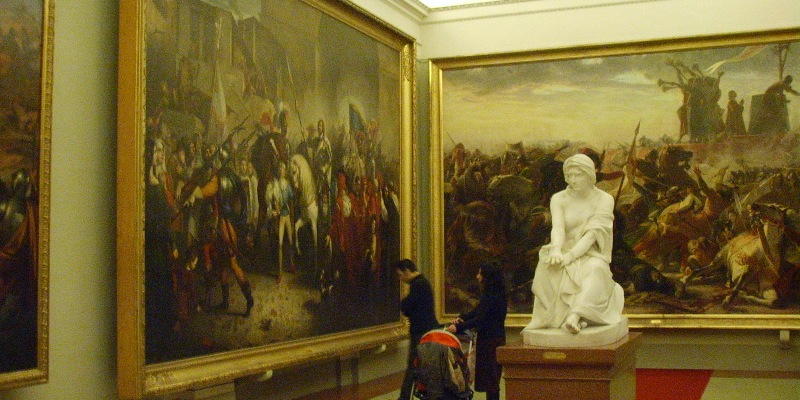
The Gallery of Modern Art is one of the museums housed in Pitti Palace in Florence. This vast collection offers a complete Italian panorama of the artistic period from the late eighteenth century (Neoclassical era) to the early decades of the twentieth century, based on Italian painting but with some important contemporary sculptures and significant examples of foreign artists. It is housed, in chronological order, in the north wing of the palace on the second floor in more than thirty rooms, one of the last areas of the palace to be converted into a museum, where representatives of the House of Savoy occasionally stayed when visiting the city until the 1930s, and where the Palatine Library was hosted, partly merged into the Magliabechiana Library, as well as part in the mezzanine known as 'degli occhi,' themed around decoration. The collection of the gallery was formed in the second half of the nineteenth century from the selection of the best works from the competitions of the Academy of Arts and Design, once displayed in the Academy gallery, and later it was enriched by numerous local collections of art from that period, such as that of Diego Martelli, acquired in 1897. The current layout dates back to 1972-1979, but restorations in the rooms also took place in 2005. The collection enjoys a particular legal discipline, with a convention between the State and the Municipality of Florence. The exhibition pathway begins with Neoclassicism, featuring works by Pietro Benvenuti like The Oath of the Saxons, Giuseppe Bezzuoli with the grand canvas The Entry of Carlo VIII, and Francesco Hayez (Samson 1842 room 2; The Two Foscari 1851-52 room 5). The most important sculptures in the early rooms are Calliope by Antonio Canova, Psyche by Pietro Tenerani, and the famous Abel by Giovanni Duprè. Numerous paintings on historical, contemporary, and older subjects document this aspect of the artistic culture of the Risorgimento well: among the most important canvases is The Expulsion of the Duke of Athens by Stefano Ussi. Among the most well-known works are those belonging to the Macchiaioli school, the Italian precursor of Impressionism, largely coming from the collections of Diego Martelli, who was an art critic and friend of the main exponents of this movement. The Macchiaioli, with their innovative research on light and the application of color 'in patches,' developed their artistic language alongside the French avant-gardes. Among the leading figures is Giovanni Fattori, present with a substantial collection of both historical works and famous Maremma landscapes, including Self-Portrait (1854 room 13), The Italian Field After the Battle of Magenta (1862 room 18), Cousin Argia (1861 room 23), The Horse that Kicked (1880 room 24), The Palmieri Rotunda, and Portrait of the Stepdaughter (1889 room 24). Silvestro Lega has notable works such as The Visit to the Wet-Nurse (1873 room 17) and Telemaco Signorini includes various works like Leith from 1881 (room 23). Other important Italian painters present here are Giovanni Boldini, with his famous portraits featuring rapid and elegant strokes; Federico Zandomeneghi (Portrait of Diego Martelli 1879 room 16); Francesco Podesti (whose sharp Portrait of the Poetess Elizabeth Barrett Browning with her son Robert is on display); Antonio Donghi, Giorgio Morandi, Filippo De Pisis, the Futurists like Giacomo Balla and Filippo Marinetti; and Elisabeth Chaplin. There are also works of sculpture (the most interesting by Adriano Cecioni, who vigorously and immediately applied to statuary the research of the Macchiaioli) and engravings.
Are you a local? What do you think about Gallery of Modern Art - Palazzo Pitti?
Login to suggest it!



















 Find the best hotel offers and save up to 80%