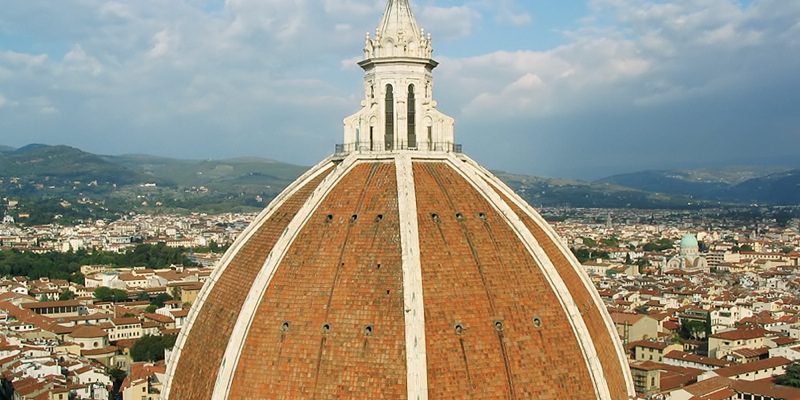
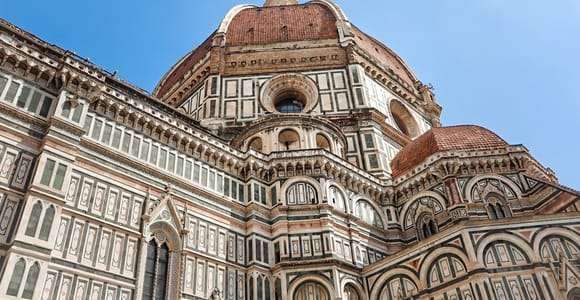
Its greatness prevented the traditional construction method using the aid of centering, leading to many hypotheses about the construction technique employed. The current building of the Duomo was started in 1294-1295, and the base of the drum of the dome was ready as early as 1314-1315; however, at the beginning of the 1400s, no one had seriously addressed the problem of finding a solution for the roof. The problem of its construction had long troubled the workers of the Duomo. How to build and where to support the enormous wooden centering that would have to hold it until its definitive closure with the key stone? Surely the architect, Arnolfo di Cambio, must have foreseen this if he imagined the conclusion of his building with a dome, a structure very different and much larger than the traditional lantern of medieval cathedrals. That the dome should have a design that was considerably more conventional is evidenced by a well-known fresco by Andrea Bonaiuti from Florence, which we can still admire today in the Cappellone degli Spagnoli in Santa Maria Novella. The fresco, which dates back to around 1355, shows a church in the background in which Santa Maria del Fiore is clearly recognizable, only that the dome, lacking a drum, is depicted as a complete semicircle. But a hemispherical dome, albeit smaller and lacking a drum, would have had enormous difficulties in bearing the weight of the lantern that the dome is equipped with in the fresco. In 1418 the Opera del Duomo announced a public competition for the construction of the dome. Following the competition, which officially did not have winners, Filippo Brunelleschi and Lorenzo Ghiberti were appointed as chief masters. On August 7, 1420, the construction of the dome began, which was completed up to the base of the lantern on August 1, 1436. The grandiose construction site opened its doors the day after the drafting of the so-called "dispositivo" of 1420, attributed to Brunelleschi himself, which outlined how the drum would have to be closed and specified the salient points of the construction methods. Essentially, it was a unique "work program" that summarized in a few lines the structure, shape, and dimensions of the artifact; more than expressing a programmatic intention, Brunelleschi stated the project by giving executive provisions. In those twelve points that he listed, the final work was not only contained, but even those variations, incidents, and additions that would need to be made were indicated: for example, the insertion of numerous iron rings into the walls of the Dome to support the scaffolding on which the authors of the frescoes would work. In 1425, Ghiberti was removed from the work, which then passed entirely into Brunelleschi's hands. The construction site proceeded without appreciable interruptions until, in August 1436, the completion of the factory was finally celebrated officially, with the solemn blessing of Pope Eugenius IV. The consecration was solemnized by the world premiere performance of the celebrated isorhythmic motet by Guillaume Dufay, Nuper rosarum flores, referring precisely to the coat of arms of Florence and the dedication of the basilica to Santa Maria del Fiore. After the construction of the dome was completed, another public competition was called for the lantern, once again won by Brunelleschi. However, work began only in 1446, a few months before the death of the great architect; it then continued under the direction of his friend and follower Michelozzo di Bartolomeo, to be completed by Antonio Manetti on April 23, 1461. Starting from an octagonal drum, the Dome rises on eight segments, the sails, organized on two shells separated by an empty space. The reason for this choice is undoubtedly to lighten the structure, which would otherwise have been too heavy, probably, to be supported by the four underlying pillars. The space between the two shells measures about 1.20 meters, and it is through its path that one reaches the Lantern. A wooden chain made up of 24 beams connected by brackets and iron pins surrounds the entire construction. Its effectiveness has been long debated. In short, today we can assert that, in principle, a dome is more stable the firmer its drum (and its base) of support is: therefore, an effective bracing system is useful for stability. This ring, in fact, serves to "tighten" the construction at the base, countering the dangerous forces directed outward. Regarding the use of wooden or stone chains, however, doubts remain, if only because of the elasticity of wood and the incapacity of stone to work under tension. Among the elements that make up the Dome, there are golden proportions, as was common at that time. The feeling one has, in fact, when observing this masterpiece, is of substantial equilibrium and harmony among its parts. Its base of support is located about 55 meters from the ground, the lantern is 21 meters high, the drum measures 13 meters, and the height of the Dome is, on average, 34 meters. The total elevation of the entire structure, including the golden ball and the cross that surmount it, is 116.50 meters. It should be noted, however, that the actual measurements of the Dome should be calculated in Florentine arms and not according to the decimal metric system; therefore, any suggestive speculation referring to the belonging of the numbers 13, 21, 34, 55 to the famous Fibonacci sequence is entirely erroneous and nonsensical. When the Dome was consecrated in 1436, a famous Flemish musician, Guillaume Dufay, composed for the occasion the motet Nuper rosarum flores, a composition that reproduced in music the relationships of the construction. The apparent contour of the Dome also respects well-defined rules: the external angular profile is a sixth of an acute fourth, while the internal one is a sixth of a fifth acute. Each diagonal of the external octagon, measuring about 54 meters, was divided into four equal parts: hence the definition of "acute fourth." The profile of the Dome, in any case, takes on a shape of extreme importance for its stability: in fact, it closely resembles that of an inverted catenary. This name comes from the fact that its shape is that assumed by a hanging chain, holding its two ends fixed. As Bernoulli would only demonstrate in the late 1600s, such a shape is the most suitable for supporting a dome that is held by its own weight. At the summit, we find the Lantern, completed with the intervention of more artists after Brunelleschi's death in 1446. To realize it, machines were used that the architect himself had designed. These machines, necessary for elevating materials during the construction of the Dome, and which in themselves marked a remarkable advancement in construction science, are generally seen by almost all authors who deal with the construction, from Vasari to Ross King, as an application of the techniques elaborated by Brunelleschi for his famous clocks, of which, apparently, only one surviving specimen remains, that of the tower of the palazzo of Scarperia. The Lantern also has a very important function for the overall statics. The ribs, in fact, converge towards the corbel, the base of the Lantern, whose diameter is about 6 meters. The forces acting on the Dome are such that the ribs themselves tend to bend inward due to the loads and their own weight. The Lantern, with its enormous weight (about 750 tons), serves to counter these dangerous forces by wedging into the structure and nullifying the thrusts that are generated at its base. In 1472, Verrocchio constructed the bronze ball that was placed on its top, also requiring Brunelleschi's machines. Among the apprentice boys who helped Verrocchio in this difficult operation was a young Leonardo da Vinci. The night between January 26 and 27, 1600, at around 5 in the morning, due to a lightning strike, the ball fell, damaging the dome in several places (it was repositioned in 1602; behind the square under the dome, a marble disc still testifies to the exact point where the original sphere crashed to the ground). The octagonal drum on which the dome was to rest measured about 43 meters in width and was at a height of 54 meters. These dimensions were significantly larger than initially foreseen. The reasons for this increase, which brought the dimensions of the building to exceed those of the Pantheon dome, until then the largest dome in the world, so much so that legend considered it a work of the devil, must be sought not so much in the desire for primacy, but in the necessity to maximize the reinforcement of the dome's drum. In fact, the drum had been raised compared to the original model through a plan in which eight large openings opened, favoring the illumination of the tripartite apse of the Cathedral. With this device, the supporting plane of the dome was also lifted above all the vaults built until then. The extremely high vaults of the Beauvais Cathedral in France, which due to their daringness collapsed shortly after their construction, indeed reached "only" 48 meters in height. But the irregular octagonal drum also created the main obstacle to the erection of the dome. Brunelleschi accurately calculated every detail, from the inclination of the walls to the arrangement of the bricks in a herringbone pattern. In this way, the dome was able to support itself without resting on traditional sulfurous wooden scaffolding. A hemispherical dome (or parabolic, or ellipsoidal, as in the dome of Pisa) is a figure or locus of points characterized as an arch "rotated" around its own axis. In this case, we speak of a dome of rotation. It is theoretically always possible to build a dome of rotation, as the dome is made up of infinite arches, each of which, once completed, will stand alone. Starting to build the dome from the edges, small arches will be created that can hold themselves up, which in turn will support wider arches leaning against the previous ones, which once completed will be self-supporting. The concern of the chief masters who succeeded each other in the Duomo construction sites was motivated by the fact that the project was for a dome with flat faces, which is not a solid of rotation. The dome of the Florence Cathedral is not a dome but an octagonal vault, describable as the intersection at 45° of two vaults with a square plan (very similar, in fact, to the vaults of the nave of the same Cathedral). Unlike a dome of rotation, a vault is not self-supporting. The use of centering, that is, wooden scaffolding to support the walls under construction until the mortar set, was in this case indispensable. Among other things, in Italy it was not possible to obtain the gigantic beams available in Northern Europe instead. But even the immense beams used for the cathedrals of France and England would not have sufficed to support vaults like those that needed to be built. Filippo Brunelleschi was famous in Florence, in addition to being a versatile artist, for having a bad temper and a somewhat perverse sense of humor; one of his pranks, played on a poor carpenter named Grasso, was famous in the world of Florentine society brigades: through a series of expertly orchestrated testimonies, Filippo made the poor man believe he had become another person, a scoundrel perpetually in trouble named Matteo. The success of the hoax was such that Grasso ended up fleeing the city, and the story of the cruel prank, titled Novella del Grasso legnaiuolo, was a real editorial success, coming down to us in numerous versions. Brunelleschi, it seems to suggest, was a master at making one thing believe to be another; not by chance, Brunelleschi is the father of perspective, which is an illusionistic representation of a three-dimensional reality using two-dimensional means. Now, Filippo with his dome seems to have played a prank of this kind on us, even more extraordinary than the other; after years of debate on what the "magic device" that had allowed the result that stands before everyone was, no one had made any progress. The octagonal dome with flat faces, to be built without centering and with the slow-setting mortars of the time, could not be self-supporting. The use of the herringbone arrangement of the bricks, visible to all in the corridors of the interspace between the two domes, was generally indicated as a component of the "secret" but without its real function being understood. One of the most widely accepted explanations is that expressed separately by Professor Salvatore Di Pasquale (former dean of the Architecture Faculty of Florence) and Professor Mainstone. These and other scholars were helped by the discovery, during the removal of the tiles from one of the sectors of the dome for restoration work, that the beds of the bricks were not horizontal at all, but followed an upward-curving slope, called slack-cord. This fact, never noticed before, led to examining the arrangement of the bricks, which in previous studies had always been taken for granted, with obscure and vague references to Roman masonry techniques or even Arabic ones. It was thus possible to observe that the faces of the bricks are not parallel but arranged along straight lines originating from a point located at the center of the base octagon of the dome. The conclusion was disconcerting; the bricks were arranged as if they had been laid out to construct a dome of rotation. To simplify as much as possible, it was as if the dome with flat faces had been constructed by cutting away parts of masonry built like a classic dome; for the structure to be self-supporting, it was therefore sufficient that it was possible to inscribe a dome of rotation of a thickness suitable for the static requirements within the thickness of the walls. However, not being able to build the dome with such large thickness as to contain a rotating one, Brunelleschi introduced the double shell and the intermediate ribs through which the circular form of the rotating dome could pass from the inner shell (where it reaches the intrados at the corners of the octagon) to the outer one (where it reaches the extrados at the median points of the sides). The herringbone-brick arrangement therefore served to measure the construction of the rotating dome, the latter being intended to support the structure during construction until it was closed in a key, avoiding thus the use of immense centering. Thanks to the study of Roman domes, geometry, but above all thanks to meticulous planning that lasted for years, Brunelleschi was able to build the octagonal dome without the aid of centering, which remains to this day the largest masonry structure ever built. In recent years, new theories have been put forward, the best-known of which is the one formulated by Professor Massimo Ricci. According to this theory, the dome technology would not correspond at all, not even in the internal structures, to a dome of rotation: the herringbone bricks would not be arranged in circular courses, but parallel to the surfaces of the sails. In this reconstruction, the structure of the dome is conceived as a succession of horizontal radial bands. Recent verifications on this construction hypothesis, made in the intrados of the shells, would confirm that the structure of the dome was developed in a radial-vertical direction and not horizontal, as the hypothesis of rotation would require. The use of a horizontal radial system is limited to the arrangement of the herringbone bricks; Brunelleschi would have used a pseudo-circular curve placed on the circumferential deck of the dome and a center on the vertical of the monument, materialized via crossed cords weighted over the diagonals of the base and fixed at the relative corners. In this way, it was possible to outline the angles of the dome using small movable centering, and at the same time (with the pseudo-circular curve to which a movable string tied at one end on this and passing through the center on the vertical) provide the bricklayers with a reference at every point of the construction for laying the bricks. This would be, according to Ricci, the actual role of the herringbone bricks, which explains the slack-cord masonry seen by Di Pasquale in the famous photo of the sail of the Dome without the tiles. This theory was put into practice in the masonry model (partially to scale) erected under the direction of Professor Massimo Ricci in the Anconella park in Florence, where the above-mentioned construction technologies and construction method were used. In reality, Brunelleschi had no technological reference to solve the problem of constructing a sector dome (i.e., a groin vault with an octagonal plan); he literally had to invent the construction process in all its mechanics. All the other domes that have been proposed as models for Brunelleschi's either were domes of rotation (self-supporting) or could be built with centering and bracing, whereas that of Santa Maria del Fiore did not allow these expedients and therefore its construction was an absolute unique case in the history of architecture. It is undoubted that Brunelleschi was well aware of the geometry and construction technique of the covering of the Baptistery of San Giovanni, built on a shell with an acute profile from an octagonal plan. But it is not ribbed in herringbone. Regarding the second source of inspiration, we are led to Rome by the news from the most important biographer of the architect, Antonio di Tuccio Manetti, in whose work it is stated that Brunelleschi would have spent years studying there, possibly drawn by the discoveries of objects and sculptures from those years. At the beginning of the 1400s, the Eternal City was an enormous archaeological site. It was here that he breathed in the suggestions of classical architecture and confirmed Vitruvius's theories, according to which all architecture is governed by a module and a geometric grid. But the most famous dome of antiquity, that of the Pantheon, is a rotating dome made of concrete with formwork. The construction technique was not reproducible and, indeed, it must have been completely incomprehensible in the Italy of the Early Renaissance, which had lost memory of the Roman concrete techniques. From studying the exterior, Brunelleschi could at most have realized that the stepped shape rose from a circular form and therefore that Roman domes generally always contain a complete circular ring at every level within their thickness. Perhaps Brunelleschi appreciated the dome of the Domus Aurea, raised on a lower octagonal pavilioned part and built with a sort of fresh concrete, which required centering during setting. The hypothesis of Brunelleschi's Roman trip is generally accepted by all critics, but it has recently been pointed out that, once one renounces (as is necessary) to derive the dome of the cathedral from that of the Pantheon, nothing in the work of the great architect must necessarily be traced back to architectural elements that were only visible in Rome. The trip to Rome is therefore possible, but not indispensable for understanding the formation of the Brunelleschian architectural canons. For the Persian source, some want to hypothesize that the architect became aware of the construction techniques of Eastern mausoleums, given the intense commercial exchanges with the Middle East. The double unbraced dome of the mausoleum of Soltaniyeh, in Iran, built between 1302 and 1312, or the herringbone masonry of the ancient Seljuk buildings (10th century) or the later mosques of Isfahan and Ardistan are comparable to the structural language and technique of Brunelleschi, although they differ significantly in materials, masonry, and dimensions. Although built with revolutionary techniques, the dome was still born from direct inspiration from the dome of the Baptistery, which gave it great development and the octagonal form. Originally, another element was intended to echo the venerable Romanesque dome; in fact, the internal decoration was planned as a mosaic. Brunelleschi made numerous openings through which the decorators could venture into the dreadful void to work. But the mosaic technique was now very little practiced and considered extremely expensive. Moreover, the mosaic raised concerns about the significant weight that the preparation required to embed the tiles would add to the dome; this concern may not seem very important to us moderns who know the immense weight of the dome (about 25,000 tons!) and its resistance, but at the time it was considered a not secondary reason to abandon the project in favor of a fresco decoration. Work only began in 1572, during the height of Mannerism. Political events had delayed the start of work until Giorgio Vasari undertook the decoration on commission from Ferdinando I de' Medici. At Vasari's death, however, only the first round of the concentric bands planned was completed, the smallest around the octagonal oculus at the top, covered by the Lantern. He was succeeded by Federico Zuccari, who, in a few years, and, according to him, almost without help, completed the immense figurative cycle in tempera, one of the largest in the world by surface area and one of the masterpieces of Mannerism; the painter himself, in his will, remembered not without pride that he conceived and completed the work, especially mentioning the large lucifer, which is 13 Florentine arms high (about 8.5 meters). After the construction of the dome was completed, the upper part of the octagonal drum remained to be decorated. The theme, dimensionally speaking, had already been hinted at by Brunelleschi in the wooden model attributed to him (preserved at the Museum of the Opera del Duomo). This was followed by the model created by Antonio Maria Ciaccheri between 1452 and 1460, which likely incorporates some indications from Brunelleschi himself; the model attributed to Giuliano da Maiano also dates back to the 1400s. However, the issue remained unresolved until the early 1500s, when a competition was called for the completion of the drum. Several architects participated in the competition, each with their wooden models: Andrea Sansovino (who anticipated a crowning with a balcony screened by Ionic columns), Giuliano and Antonio da Sangallo the Elder (where the balcony is absent), Il Cronaca together with Giuliano da Sangallo and Baccio d'Agnolo, as well as Michelangelo Buonarroti. In particular, in the summer of 1507, Michelangelo was commissioned by the Operai of Santa Maria del Fiore to present a drawing or model for the drum competition by the end of August. According to Giuseppe Marchini, Michelangelo sent some drawings to a carpenter in Florence for constructing the model, which the same scholar recognized in the model identified with number 143 in the series preserved at the Museum of the Opera del Duomo. It presents a decidedly philological approach, aimed at maintaining a certain continuity with the pre-existence by inserting a series of rectangular mirrors in green marble from Prato aligned with the capitals of the corner pilasters; an elevated frieze was planned, closed by a cornice with shapes similar to that of Palazzo Strozzi. However, this model was not accepted by the judging commission. In 1512, the decision was made to start the works for the completion of the drum according to a project prepared by Baccio d'Agnolo together with Il Cronaca and Giuliano da Sangallo. Baccio d'Agnolo himself, then chief master of the Opera di Santa Maria del Fiore, was commissioned to oversee the construction site; the project provided for the insertion of a massive balcony supported by white marble columns at the top of the drum, with nine arches on each side (later increased to eleven during construction). However, work was halted in 1515, with the balcony only completed on the side of the dome facing via del Proconsolo, both for the lack of favor received and due to Michelangelo's opposition. And here’s the anecdote. Baccio decided to stop and ask for the opinion of the people of Florence. Michelangelo Buonarroti was staying in the city, and he was naturally called upon. Looking at the work, after a while he seemed to exclaim: "It looks like a cage for crickets!!!". Baccio d'Agnolo, a highly sensitive artist, felt offended and left the drum unfinished, just as we see it today (only the side facing via del Proconsolo remains). Around 1516, Michelangelo did execute some drawings for the completion of the drum (preserved at Casa Buonarroti) and probably had a new wooden model constructed, identified, albeit with considerable reservations, with number 144 in the inventory of the Museum of Santa Maria del Fiore. Once again, the balcony was abolished, in favor of greater prominence of the supporting elements; in particular, a drawing shows the insertion of high free paired columns at the corners of the octagon, topped by a series of strongly protruding cornices (a scheme that would later be elaborated for the dome of St. Peter's Basilica in the Vatican). Michelangelo's ideas remained on paper, and the drum was left incomplete on seven of its eight sides.
Are you a local? What do you think about Brunelleschi Dome - Duomo?
Login to suggest it!
















 Find the best hotel offers and save up to 80%