The Coppedè district is a complex of buildings located in the Trieste neighborhood, between Piazza Buenos Aires and Via Tagliamento.
While not strictly a neighborhood, it was named after the architect who designed it, Gino Coppedè.
It consists of eighteen palaces and twenty-seven buildings, including small palaces and villas, arranged around the central nucleus of Piazza Mincio.
In 1915, the Società Anonima Edilizia Moderna, headquartered in Piazza Pietra, with Aonzo Arnaldo as CEO, envisioned a residential area in Rome, adjacent to Piazza Quadrata (Piazza Buenos Aires), on the border between the Parioli and the then-new Salario and Trieste neighborhoods.
The project was entrusted to Gino Coppedè.
The financiers Cerruti, along with Coppedè, wanted to replicate in Rome the path initiated in Genoa with Coppedè himself.
The neighborhood was born from the Bonfiglietti master plan of 1909, amid many difficulties and conflicts between the construction commission and architect Coppedè, with constraints imposed by the superintendency of the construction commission, as happened in 1918, under the authority of the then-urban planning councilor, Galassi, on the Via Po plot.
Although Pevsner, Fleming, and Honour's architectural dictionary cites 1912 as the date, the first presentation of the project is said to have taken place on October 19, 1916, and the design would therefore date back to 1915, when Coppedè was commissioned by the financiers Cerruti and Becchi.
In 1921, the Palazzi degli Ambasciatori were completed, and the district remained unfinished after Coppedè's death in 1927.
The neighborhood was completed by Paolo Emilio André.
The project initially included the construction of 18 palaces and 27 buildings, including small palaces and villas.
On August 23, 1917, the construction commission requested Coppedè to give the neighborhood a Roman imprint.
Thus, Coppedè utilized the theme of ancient Rome, incorporating moldings and frames inspired by Imperial Rome and an arch reminiscent of the triumphal arches of the Roman Forum.
In February 1918, the project for the Palazzi degli Ambasciatori was approved on the condition that the diagonal street (present-day Via Dora) be closed to become a private road.
In 1920, the construction of the Villini delle Fate on Via Rubicone was rejected.
For its realization, travertine was used (again in homage to Imperial Rome), while the interiors were crafted with glazed majolica for the kitchens, wood parquet for the living rooms, and Pompeian-style mosaics for the bathrooms.
The main entrance to the Coppedè district, from the side of Via Tagliamento, is marked by a grand arch connecting two palaces.
Just before the arch stands a niche with a statue of the Madonna and Child.
Beneath the arch, in addition to two balconies, there is a large wrought-iron chandelier.
The arch is adorned with numerous architectural elements, characterized by their asymmetrical arrangement.
Beyond the arch lies Piazza Mincio, the heart of the neighborhood.
In the middle of the square stands the Fontana delle Rane, built in 1924.
The fountain consists of a central basin, a few centimeters higher than street level, with four pairs of figures, each supporting a shell upon which sits a frog from which water spouts into the basin.
From the center of the fountain rises a second basin, about two meters high, whose edge is surmounted by eight more frogs.
The arch above the entrance to the palace at number 2 in the square is a faithful replica of a set design from the 1914 film Cabiria.
Due to its unique architecture, the Coppedè district was chosen by director Dario Argento as the backdrop for some scenes in his films Inferno and The Bird with the Crystal Plumage, and in 1976 by director Richard Donner for the opening sequences of the film The Omen.
Among the films shot in the district, there's also the 1974 film noir The Perfume of the Lady in Black by director Francesco Barilli and some scenes from The Sky in a Room by Carlo Vanzina.
Tenor Beniamino Gigli had his Roman home in one of the villas in the neighborhood.
On Via Tanaro, you'll find the South African Embassy, while on Via Brenta, you'll find the Moroccan and Bolivian embassies.
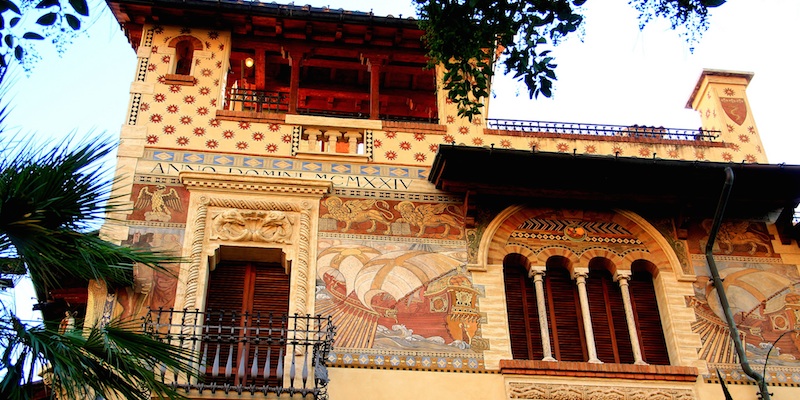
The living room interiors were divided from the private areas, almost forming «reception areas» and «sanctuaries of private life.» In the Villini delle Fate, Florence is celebrated with the inscription «Fiorenza bella» and Florentine decorations featuring Dante and Petrarch.
On the other hand, the side facing Via Brenta is dedicated to Venice with a lion of St. Mark.
The Palazzo del Ragno pays homage to work through a decoration depicting a knight with the inscription «labor.»
Are you a local? What do you think about Coppedè Neighborhood?
Login to suggest it!


















 Find the best hotel offers and save up to 80%