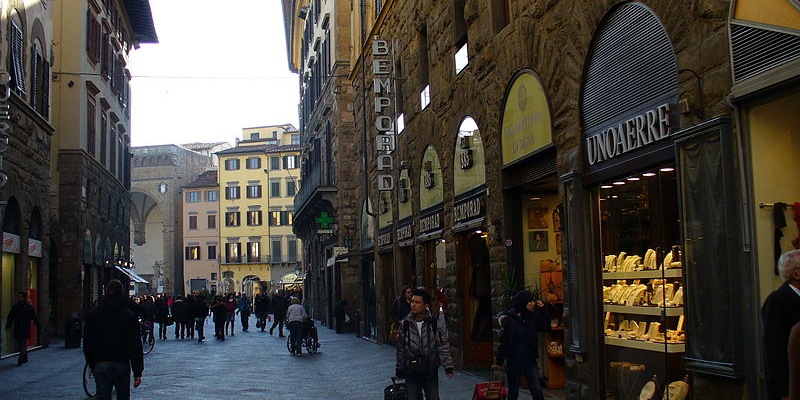
Via dei Calzaiuoli is undoubtedly the most central and among the most elegant streets in Florence, a constant destination for intense pedestrian traffic. The street, about four hundred meters long, is without sidewalks, as it has been in a pedestrian zone for many years, and along its sides are many of the most elegant shops in Florence. It was first widened in the 15th century when it was dedicated to the numerous clothing and footwear shops that had their premises there. A natural link between religious and political power (between Piazza del Duomo and Piazza della Signoria), before that it was divided into narrower segments, each of which had various names: Via dei Cacioli (cheese sellers), Via de' Banderai, Via dei Farsettai, Via de' Bonaguisi (a merchant family, of which the palace with the coat of arms at the corner of Via della Condotta still remains), the Corso dei Pittori or of San Bartolo (see the next section), Via dei Brigliai and the Corso degli Adimari (see subsequent sections). Apart from the presence of two family names, all these names emphasize the commercial vocation of the street. Among the artist workshops, Donatello and Michelozzo had their labs here. In the 14th century, two important churches were built on the street: Orsanmichele and San Carlo dei Lombardi, in addition to a few other small churches that have now disappeared (such as Santa Maria Nepotecosa). In particular, in the niches of Orsanmichele, some famous Renaissance statues align (currently in copies), each commissioned by a Guild and dedicated to their respective patron saints. The works of great sculptors such as Donatello, Verrocchio, Lorenzo Ghiberti, Giambologna, and Nanni di Banco have now been replaced by copies. Discussions about a new widening began at the start of the 19th century, with an initial project by architect Giuseppe Del Rosso, commissioned to create a new commercial artery in the city. The project remained shelved, and in 1826 a new proposal was put forward to build porticoes on both sides (designed by architect Luigi de Cambray-Digny), but they were never realized due to administrative issues related to expropriation. The Bazar Bonajuti was located on Via Calzaiuoli as early as 1834, the first true bazaar in Florence, created as a huge covered square on two floors, where from 1907 until 1988 was located Duilio 48, a famous precursor of department stores well-known to all old Florentines (today those very rooms, refurbished and modernized, are used by Coin retail outlet). Expansion projects followed one after the other without ever reaching implementation until 1842 when work began. To reach today’s width of 14 meters, a large number of buildings had to be demolished and resized, including a well-preserved tower right at the corner with Piazza Duomo. The porticoes were not built, thus leaving the street wide and well-suited for pedestrian traffic. The entire area near Piazza del Duomo was thus the headquarters of the Adimari; in fact, this section was called Corso degli Adimari. At a corner between Via de' Calzaiuoli and Via delle Oche stood a family loggia belonging to the Adimari. Such loggias were very common in the city (today a well-restored example is the Rucellai Loggia in Via della Vigna Nuova) and were a source of pride for the families who owned them, used for anniversaries, weddings, celebrations, significant public and private affairs, displaying their rank and sometimes with the aim of impressing rivals and the 'plebs.' However, the Adimari loggia was sadly notorious as a gathering place for idlers and slackers, to the extent that it was known as 'Neghittosa' (from the Latin neglectus, meaning lazy). This urban corner is still called 'Canto alla Neghittosa,' and it was also a meeting point for one of the celebratory powers, that of 'King Piccinino alla Neghittosa.' Besides the mentioned loggia, there was a tower-house, demolished in the 19th century, once located at the head of the street, next to the palace of the Venerable Arch Confraternity of Mercy; in the garage of the Confraternity, there was a small church named San Cristoforo degli Adimari, of which only the family crests remain. The small church of Santa Maria Nepotecosa, at the corner with the current Via del Corso, was also patronized by the Adimari. Instead of the Loggia del Bigallo, there once existed the so-called Torre del Guardamorto, also of the Adimari, which was destroyed in 1248 after the expulsion of its owners, who were Guelphs. Two of the surviving towers of the Adimari are: one at the corner with Vicolo degli Adimari, incorporated into a later palace, and another, better preserved, at the corner with Via dei Tosinghi. The stretch between Vicolo del Giglio and Orsanmichele was called Corso San Bartolo, or dei Pittori, because many artists had their workshops there, which served as studios and galleries for displaying their works of art. Here was the church of San Bartolomeo, the protector of painters, which had a portico of polychrome marbles, in Romanesque-Tuscan style, and was under the patronage of the Macci. In this corso, the famous blacksmith Niccolò Grosso, known as il Caparra, had his workshop, who lived in the late 15th century and whose name stemmed from the practice of asking for a deposit (or 'caparra') for every commissioned work. His masterpiece is the lanterns at the corners of Palazzo Strozzi. Above his workshop, there was a wrought iron sign painted in bright colors, representing a pile of burning registers on a pyre, to indicate that he loathed record-keeping. His mastery was such that Giorgio Vasari mentioned him in his Vite. Opposite the Corso San Bartolo dei Pittori is Vicolo dell'Onestà, which leads to the Piazza dei Tre Re, where the Magistrate of Honesty resided, tasked with overseeing morals. In this piazza, there were also the loggia and tower of the Macci, owners of the houses between the piazza and Via Calzaiuoli. The stretch between Via della Condotta and Piazza della Signoria is the only one that has maintained its ancient appearance, having had its current width since 1383. The building at numbers 2-12 Rosso is the ancient Bombicci palace, followed, beyond Via della Condotta, by the Buonaguisi palace, while on the opposite side, numbered as Piazza della Signoria 4a, is the ancient palace of the Arte dei Mercatanti or di Calimala. Beyond the intersection of Via di Porta Rossa, there is the palace of the Cavalcanti, with an ancient shield, and adjacent to it is the seat of the Compagnia di Orsanmichele or dei Laudesi, with the initials OSM carved. The entire street is rich in commemorative plaques. At number 10, a plaque commemorates the discovery of the foundations of the Roman city walls, which took place during the street's demolition. At number 11 Rosso, on the palace of the Cavalcanti, there is a Dante plaque recalling the verses dedicated to Guido in a passage from the Inferno (X, 58-63). At numbers 56-58, a plaque remembers the church of San Bartolomeo, deconsecrated in 1768 and then demolished. Another church that had a similar fate, Santa Maria Nepotecosa, is remembered at number 72 Rosso. At number 83 Rosso, on the wall of a house, the coat of arms of Gualtieri VI of Brienne, the hated Duke of Athens who tyrannized the city between 1342 and 1343, is displayed. It was placed by one of his supporters, Cerrettieri Visdomini, and a plaque recalls this unfortunate choice, stating how "by evil ambition led, his houses in disgrace to the oppressed city, contaminated not unpunished." At 97 Rosso, another plaque recalls the workshop of Donatello and Michelozzo, who worked "as brothers." At 105 Rosso, a rectangular slab preserves the memory of Corso degli Adimari and the houses of the family. Finally, at numbers 122-124 Rosso, there is a large marble slab that commemorates the widening of the street between 1842 and 1844 under Leopold II of Lorraine.
Are you a local? What do you think about Via dei Calzaiuoli?
Login to suggest it!


















 Find the best hotel offers and save up to 80%