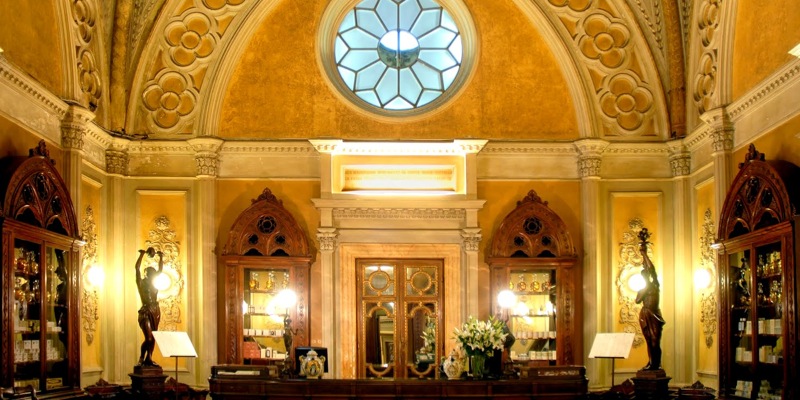
The Santa Maria Novella perfumery-pharmacy, or Farmacia di Santa Maria Novella, or Antica Spezieria di Santa Maria Novella, is located at Via della Scala 16 in Florence, within part of the convent complex of Santa Maria Novella. Today, it is considered the oldest historical pharmacy in all of Europe, active continuously for nearly four centuries, as well as one of the oldest commercial establishments in existence; for this reason, in 2012, an Italian postage stamp was dedicated to it, and a restoration project for some monumental rooms was also initiated. As early as 1381, it is documented that the Dominicans of Santa Maria Novella sold rose water as a disinfectant, particularly used during epidemics. The friars cultivated medicinal plants (the simples, from which the name of the Garden of Simples derives) in an adjacent garden, distilled herbs and flowers, and prepared essences, elixirs, ointments, and balms. The Garden of Simples primarily supplied the nearby and sister Pharmacy of San Marco, also founded and managed by the Dominican friars. The current perfumery dates back to 1612 when it still performed the activities of a drugstore. Renowned throughout Europe, it received from Grand Duke Ferdinand II de' Medici the title of Foundry of His Royal Highness in 1659, during the stewardship of Fra' Angiolo Marchissi. In the 18th century, its products were exported to the Indies and China. Today, it is considered one of the oldest commercial activities in all of Europe, active for four centuries. Despite the 19th-century suppressions of the convent, it remained active thanks to Fra' Damiano Beni, and in 1866 it became municipal property and was rented by his nephew Cesare Augusto Stefani, whose descendants still manage the activity today. The ancient 'spezieria', no longer a pharmacy but a perfumery and herbarium, is found in a truly monumental environment, with decorations and ancient furnishings dating from various periods. It also houses a valuable collection of scientific materials, such as thermometers, mortars, scales, measuring cups, and so on, in addition to the precious pharmacy jars from the 16th to the 20th century. Access to the perfumery’s sales area is through a finely sculpted portal made of serena stone, surmounted by a pediment in which the Dominican friars’ coat of arms is placed, recognizable by the radiant sun. The gallery leading to the Sales Hall is not the original entrance of the Pharmacy; it was actually opened only at the end of the 18th century. The official opening of the pharmacy to the public in 1612 saw access from the Chiostro Grande, now owned by the Carabinieri Noncommissioned Officers School, through a shell-shaped portal designed by Matteo Nigetti. The ancient spezieria, now Erboristeria, was the room reserved for the sale and exhibition of products from 1612 until 1848. In the classical foyer, two exedrae open laterally, each with a marble statue: Igea and Galen, representing the personification of the goddess of health and the god of medicine, respectively. The small vestibule is in neogothic style, with decorations predominantly in blue and gold, and leads to the main sales hall. The large Sales Hall was originally one of the chapels of the convent, dedicated to St. Nicholas of Bari, under the patronage of the wealthy Acciaioli family. According to tradition, the chapel was a gift of gratitude from Dardano Acciaioli to the Dominican friars. It is said that when Dardano fell ill, and doctors could neither diagnose nor treat his illness, in order to save their reputation, he was prescribed a particular grape called 'ursina' or 'lugliola', which was almost impossible to find at that time of year. The lack of healing would thus have been attributed to the difficulty in locating the 'medicine'. The friars of Santa Maria Novella, learning of this, gathered this grape from their garden and offered it to Dardano, who miraculously recovered. The nobleman, in gratitude, proposed to the Dominicans to give them something that would remain in perpetual memory, and they asked him to contribute to the construction of a chapel 'for the comfort of the sick'. The chapel was built near the infirmary, allowing the sick to follow religious functions from their beds. In the 18th century, the chapel underwent significant transformations. The friars had the entrance opened from Via della Scala and designated the chapel as a storage area, as it had become very deteriorated. A major renovation occurred in 1848, when the ever-increasing notoriety of the pharmacy made it necessary to have an appropriate space to welcome customers. All works were initiated by Fra’ Damiano Beni, one of the most important directors of the pharmacy. The space was divided into two areas: sales room and storage. The frescoes on the ceiling, where the ancient cross vault was maintained, created by Paolino Sarti, depict the four continents, symbolizing the fame of the Pharmacy and its products around the world. The furnishings consist of neogothic walnut cabinets in which the products of the workshop are displayed. To the right, one enters the so-called Green Room, facing the garden, which was built between 1335 and 1337, between the convent’s infirmary and the chapel, to make it a private apartment, but it was never used for that purpose. Since 1542, the year commercial activity of the pharmacy began with the first book of income and expenses, this room housed the pyramid stoves for distilling, the burners, and the glassware. In the 18th century, the Green Room became a reception area for distinguished guests, to whom the specialties of the pharmacy, such as Alkermes or China, and especially chocolate, a very fashionable drink at the time, were served. Today, the room is furnished with Directoire-style furniture from the 18th century. To the right, on the wall, dominates the effigy of the Dominican saint Peter of Verona by Matteo Rosselli. On the opposite wall is the coat of arms of the Dominicans of Santa Maria Novella with its richly carved and gilded frame, beneath which is the marble bust of Fra’ Tommaso Valori, one of the directors. Above are the portraits of all the directors of the Officina from 1612, the year of its official founding, onwards. The Ancient Spezieria, now Erboristeria, was the room reserved for sales from 1612 to 1848, accessed from the Chiostro Grande of Santa Maria Novella through the portal designed by Matteo Nigetti, beside which two plaques still exist that recall the pharmaceutical activity of the friars, privileges granted by the grand duke and illustrious guests of the pharmacy. The room is adorned with a rich stucco decoration of the 18th-century vaulted ceiling, with fantastic animals, sphinxes, dragons, eagles, masks, festoons of fruit and roses, all motifs favored in the repertoire of the time. Some elements, like the ribbons and festoons, reappear in the wooden carving that surmounts the 17th-century cabinets. In the cabinet located in the entrance wall, the center of the carving features a garland of golden roses, surmounted by a crown, within which is depicted the Mystic Marriage of St. Catherine of Alexandria. Used since the 17th century as an aromatherapy room, it was where distilled waters were preserved, and was also called the 'Room of Waters'. Today it has become the library of the Officina profumo-farmaceutica, where those who wish can consult the texts preserved here. The library was designed by the Florentine architect Filippo Burresi, in full respect of the strict geometries upon which the sacristy was constructed. The walls are entirely frescoed with stories from the Passion of Christ by Mariotto di Nardo, following the Giottesque tradition. The museum path of the Officina profumo-farmaceutica di Santa Maria Novella develops in what were once the production laboratories. In the desire to restore light and life to the machines once used for processing, the glassware, the ancient ceramics, and the copper and bronze objects, the museum was born. Next to the Spezieria are the large cellars where products have been stored for centuries. From here, access is also available to the herbal tea room and the ancient distillery; these spaces overlook the lovely herb garden, where the monks cultivated medicinal plants, near the second entrance on Piazza Santa Maria Novella (open only on special occasions). Throughout the Pharmacy, various scientific instruments and containers from the 17th to the 20th century are displayed. The collection consists of three main groups: pharmacy ceramic jars (from the Montelupo, Richard-Ginori, and Chini factories), pharmacy glassware (bottles, stills, and more), and genuine scientific instruments (thermometers, mortars, scales, measuring cups). In the showcases of the Hall of the ancient Spezieria, old stills and other instruments used to extract and synthesize fragrances and medicinal compounds are displayed; the tall thermometers of the Accademia del Cimento are copies: the originals are located in the Museum of the History of Science in Florence.
Are you a local? What do you think about Officina Profumo-Farmaceutica di Santa Maria Novella?
Login to suggest it!


















 Find the best hotel offers and save up to 80%