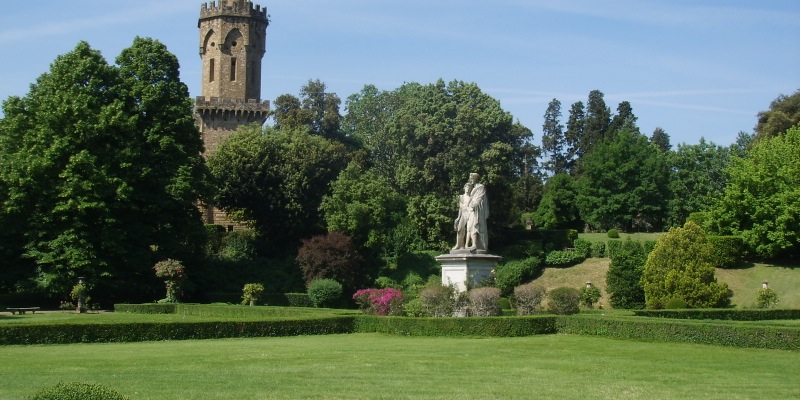
The Torrigiani Garden is located in Florence between Via de' Serragli, Via del Campuccio, and the stretch of walls that borders Viale Francesco Petrarca. It is a large park with a palace called Casino Torrigiani al Campuccio. It is one of the few large green areas still surviving within the walls, in optimal conservation status, and constitutes a typical example of the romantic style that characterized gardens in the early nineteenth century. Already in the sixteenth century, there was a Torrigiani property in the area known as "il Campuccio." By the end of the eighteenth century, with the extinction of the family, the inheritance of Cardinal Ludovico Maria Torrigiani passed to his great-grandson Pietro Guadagni, who then took on the name of his uncle and began the construction of the garden on the small property of Campuccio. Between 1802 and 1817, with subsequent purchases, the new Marquis Torrigiani expanded the property, which extended from Via del Campuccio to Via dei Serragli, the walls, and the current Piazza Tasso, reaching an area of about ten hectares. The commission to design the grand garden was given to Luigi Cambray Digny (1813-1814), who was succeeded by the young Gaetano Baccani. Thus, an English-style park was created, rich in suggestions related to the world of Arcadia and especially to the symbolism of Freemasonry, of which Marquis Pietro Torrigiani was a member. The presence of the Medici walls served to enliven the project, which was characterized by a wealth of small buildings, statues, and botanical peculiarities so much that, shortly after its creation, it warranted "a guide for the visitors." The guide mentioned over thirty points of interest, including the Hypogeum, Merlin's Grotto, the covered Carousel, the Citrus and Flower Garden, the Cavalry Stable, Arcadia, the Hermitage, the Gymnasium, the large Tower, the Aviary, the Lemon House, and the stream with its magnificent bridge. Today, the garden is not as rich in works of art; however, the environment has been well preserved and remains one of the most significant English gardens in Florence. Formerly, the entrance was from Via dei Serragli, and from there began the symbolic pathway, with a statue of Osiris, a god linked to agriculture, the world of the dead, and resurrection; the statue supports tablets that still indicate the garden's rules, a curious vestige from when the park was opened to the public in 1824. Sculpted hands on columns still indicate the paths to follow. Some areas of the park were also designated for grazing wild animals such as deer and roe deer. The current entrance on Via del Campuccio, number 53, leads into a spacious area marked by a large circular flowerbed divided into four parts, with at the center the large classical group, a work by Pio Fedi (the author of the Rape of Polyxena at the Loggia dei Lanzi), which represents Seneca with the young Pietro Torrigiani. Various sculptural elements surround it, some still retaining the original iron supports for lanterns. Not far away was Merlin's Grotto, where the legendary character was meant to evoke the theme of man's inner strength, which one can use according to their will. The garden’s interior walls were covered with frescoes of pastoral scenes and faux ruined architectures. Walking along a winding upward path, one finds on the right the small amphitheater (used purely symbolically and as a moment of rest, not suitable for theatrical performances) and the Gymnasium, a small temple in Arcadian style where one could change after playing games such as ball, archery, pistol, and rifle on the nearby lawn (today it is home to the gardeners). Next to the lawn is a small grove on an artificial hillock: the darkness of the vegetation led to the second part of the pathway, linked to the theme of night and death. There is an Hermitage in the woods and some symbolic sculptures: the urn with the serpent and an owl (the latter piece is now lost). Equally symbolic was the ossuary, a small cave preceded by a path lined with herms in Egyptian style, leading, after skirting the Medici walls, to the base of the tower, where, under a hillock, there exists a chamber symbolizing a crematory oven: from there, the "ashes" symbolically of the individual would ascend through the tower to a higher state of knowledge and a sort of resurrection. The tower, therefore, had various practical and symbolic values. It was built by Baccani in 1824 to a height of about twenty-two meters, but its location on an artificial hillock enhances its visual impact. The tower alludes primarily to the Torrigiani, who in their coat of arms had a small tower topped by three stars. Moreover, its three levels allude to the three degrees of the initiation process from the profane world to the initiatory world of Freemasonry. In practice, it served as an astronomical "specola" and housed a library, a collection of astronomical instruments, weapons, and at the top, an open terrace for observing the sky. Among the sculptures present in the garden are the baroque work of Baratta, the marble group "of Greek chisel" depicting a bull killed by a lion, the statue of Osiris adjacent to the entrance of Via de' Serragli, the marble column dedicated to the great botanist Pier Antonio Micheli who worked diligently in this location in the early 1700s, and the statues of Janus and Asclepius. The history of this garden is significant not only from an architectural perspective but also from a botanical one, evidenced by the presence of old and new greenhouses, lemon houses, warmhouses, and a large number of plants. In 1839, an inventory of the essences was compiled by A. Pucci, indicating that there were 5,500 potted plants (pineapples, camellias, rhododendrons, citrus, etc.) and over 13,000 plants in the ground, including fruit trees, magnolias, pines, and cypresses.
Are you a local? What do you think about Torrigiani Garden?
Login to suggest it!




















 Find the best hotel offers and save up to 80%